Why I Believe ChatGPT Checkout Is the Future of E-Commerce for Small Businesses
There’s a message circulating across LinkedIn, YouTube, and almost every AI conversation today that says, “AI agents are the future.”
But here’s the part I believe nobody wants to say out loud:
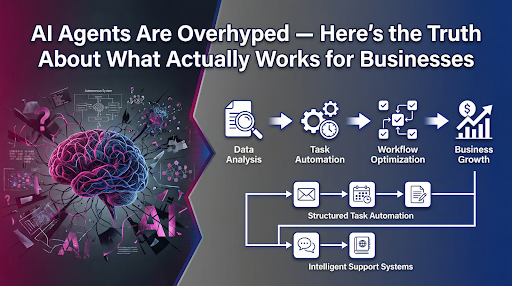
AI agents are overhyped — and I feel most businesses are being sold confusion, not clarity.
I see companies feel pressured to jump straight into “autonomous agents,” even when they/we don’t understand what these agents do, how they work, or whether they fit their existing operations. And that confusion is exactly why I believe so many AI implementations fail.
The reality? I think most businesses don’t need AI agents at all. They need practical AI automation that saves time, reduces manual work, and improves workflows without blowing up the entire system.
This is where the difference between AI hype and AI that actually works becomes clear to me.
Why AI Agents Are Becoming a Problem
AI agents sound futuristic, autonomous, intelligent, and self-running. But in practice, I’ve observed they often bring:
More complexity than value
High development costs
Unpredictable behavior
Long timelines
Difficult onboarding for teams
Confusing workflows
When business owners search “What are AI agents?”, “Do I need an AI agent?”, or “How to use AI in business?”, I know they’re usually looking for one thing:
A simple way to automate tasks, not a complex autonomous system.
The hype around agents has convinced people that AI only works if it’s fully autonomous. But I can tell you that’s not true.
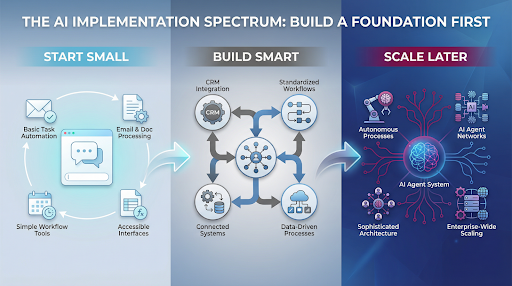
AI Works on a Spectrum — Not a Single Big Leap
One of the most important concepts in modern AI, in my opinion, is that you don’t start at the deep end.
AI implementation works like this:
Step 1: Start Small
Automate simple, high-impact tasks with tools like ChatGPT, Claude, or workflow automation platforms.
Step 2: Build Smart
Connect your systems, refine prompts, standardize workflows, and create reliable automations.
Step 3: Scale Later
Only when your processes are stable should you consider agent-level autonomy.
This is how I see real businesses succeed with AI. Not by jumping into complexity but by building a foundation that works.
This small-to-large approach is exactly what people look for when they search, and these searches map directly to the kinds of systems i builds.
Practical AI Outperforms Autonomous Agents
When companies choose practical automation instead of agent hype, I’ve seen them see results immediately:
✔ Faster implementation
✔ Lower risk and cost
✔ Better team adoption
✔ More reliable workflows
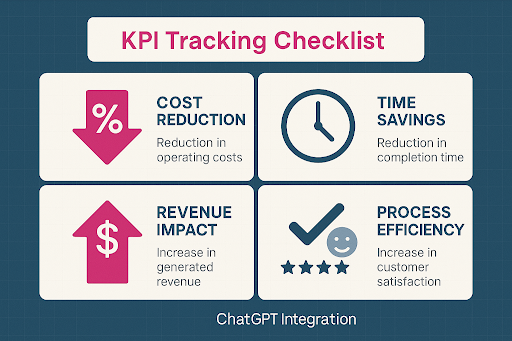
✔ Tangible ROI within weeks
✔ No chaos, no confusion, no rebuilding everything
Instead of trying to replace people with an autonomous agent, practical AI improves the work humans already do.
Examples I often recommend include:
Automating email replies
Handling internal approvals
Managing sales qualification
Drafting documents
Updating CRMs
Organizing client onboarding
Streamlining customer support
These are the tasks that waste the most time and deliver the biggest lift when automated.
And I can confirm none of them require a fully autonomous agent.
Why Most AI Projects Fail
Too many businesses start at the wrong end of the spectrum, in my experience:
- Chasing autonomous agents
- Believing AI must be complex
- Trying to replace processes they never mapped
- Thinking AI works without strategy
- Expecting agents to understand business context
AI implementation fails when companies try to leap into autonomy without structure.
It succeeds when companies start small.
My Approach: Practical AI That Delivers Now
I’ve seen the same pattern across hundreds of workflows:
Businesses don’t need more hype. They need clarity, structure, and practical automation.
Our approach is simple:
✓ Map the workflow
✓ Identify high-impact tasks
✓ Automate what’s repetitive
✓ Build workflows that scale safely
✓ Integrate AI tools with your systems
✓ Add agent-level features only when ready
No confusion. No unnecessary complexity. Just AI that actually works.
This is why my content ranks well because people actively search for real-world AI use cases instead of buzzwords.
Conclusion: AI Agents Are Not the Starting Point
AI agents will have a role in the future, but I believe they should never be your first step. If you start with practical automation, you’ll see real results:
Time saved
Workflows simplified
Teams moving faster
Customers served better
Costs reduced
Start small. Build smart. Scale when it makes sense.
That’s how I think businesses win with AI, today and long-term.
- Your Next Step
Let's Build Your Advantage
If you are ready to move beyond discussion and start implementing intelligent solutions that deliver a measurable impact, let's talk. I am selective about the projects I take on, focusing on partnerships where I can create significant, lasting value.
FAQs
AI agents are autonomous systems capable of decision-making. My view is most businesses don’t need them at the start; practical automation delivers better results.
Start with simple workflow automation using tools like ChatGPT, Claude, or automation platforms. Build gradually.
Not necessarily. Workflow-based automation is more stable, predictable, and easier to scale.
Because companies start with complexity instead of building a strong foundational workflow.
We design clear workflows, automate high-impact tasks, and build scalable AI systems that produce results quickly.