5 Questions That Saved Me $50,000 on a Fake AI Solution (Use This Test Before You Buy)
Three months ago, I was this close to making one of the biggest business mistakes of my career. I had my credit card ready to pay $50,000 for what I thought was a revolutionary AI system that would transform my small business operations.
Thank God I didn't hit "purchase."
The Moment Everything Changed
I’d been struggling with the same challenges every small business owner faces – too many manual tasks, not enough time, and the constant pressure to do more with less. When a slick sales rep showed me their “proprietary AI solution,” I was hooked. The demo looked incredible. The promises were exactly what I needed to hear.
But something felt off.
My $50,000 Reality Check
After the demo, I couldn’t shake the feeling that I’d seen similar functionality before. So I did something that probably saved my business: I started asking uncomfortable questions.
That’s when I discovered their “revolutionary AI” was basically ChatGPT with a fancy dashboard something I later learned could be built in a weekend using Zapier.
I wasn’t alone. A Wall Street Journal report I found later confirmed that countless small businesses were paying enterprise prices for what developers on Reddit were building as weekend projects.
The 5 Questions That Changed Everything
That experience taught me to develop what I now call my “BS Detector Test” – five questions that separate real AI solutions from expensive smoke and mirrors:
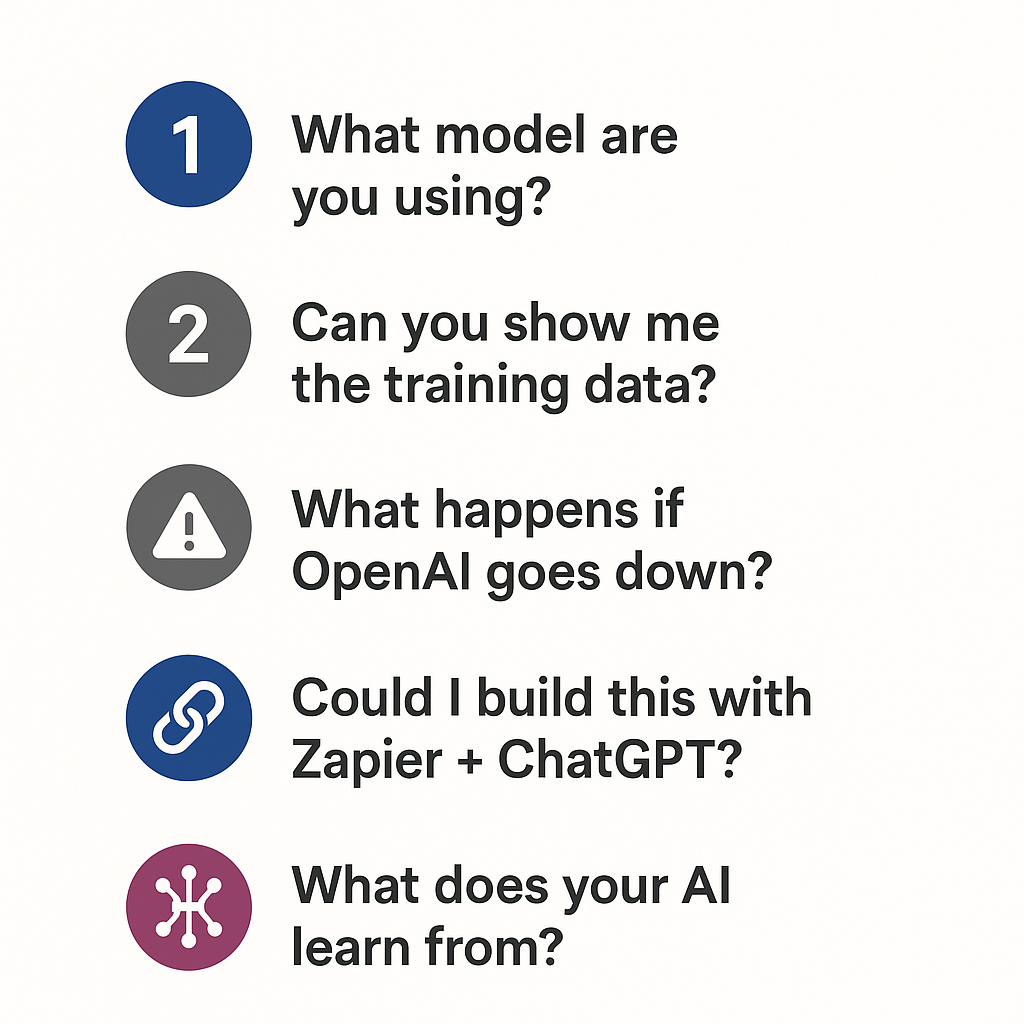
What model are you actually using?
Real companies will tell you straight up: "We use GPT-4" or "This runs on Claude." Red flag: Vague answers like "our proprietary AI engine" without any specifics.
Can you show me your training data?
Legitimate AI teams are transparent about their datasets and methodology. Warning sign: "That's confidential" or deflecting to "advanced algorithms."
What happens when OpenAI has downtime?
This question is pure gold. Real solutions have backup plans and redundancies. Fake AI? The whole system crashes when ChatGPT goes down.
Could I replicate this with Zapier and ChatGPT?
If the answer is yes and they're charging premium prices, walk away. I've learned this the hard way – twice.
How does your AI actually learn and improve?
Real AI systems have clear learning mechanisms and get smarter over time. Fake solutions either can't answer or give you marketing fluff.
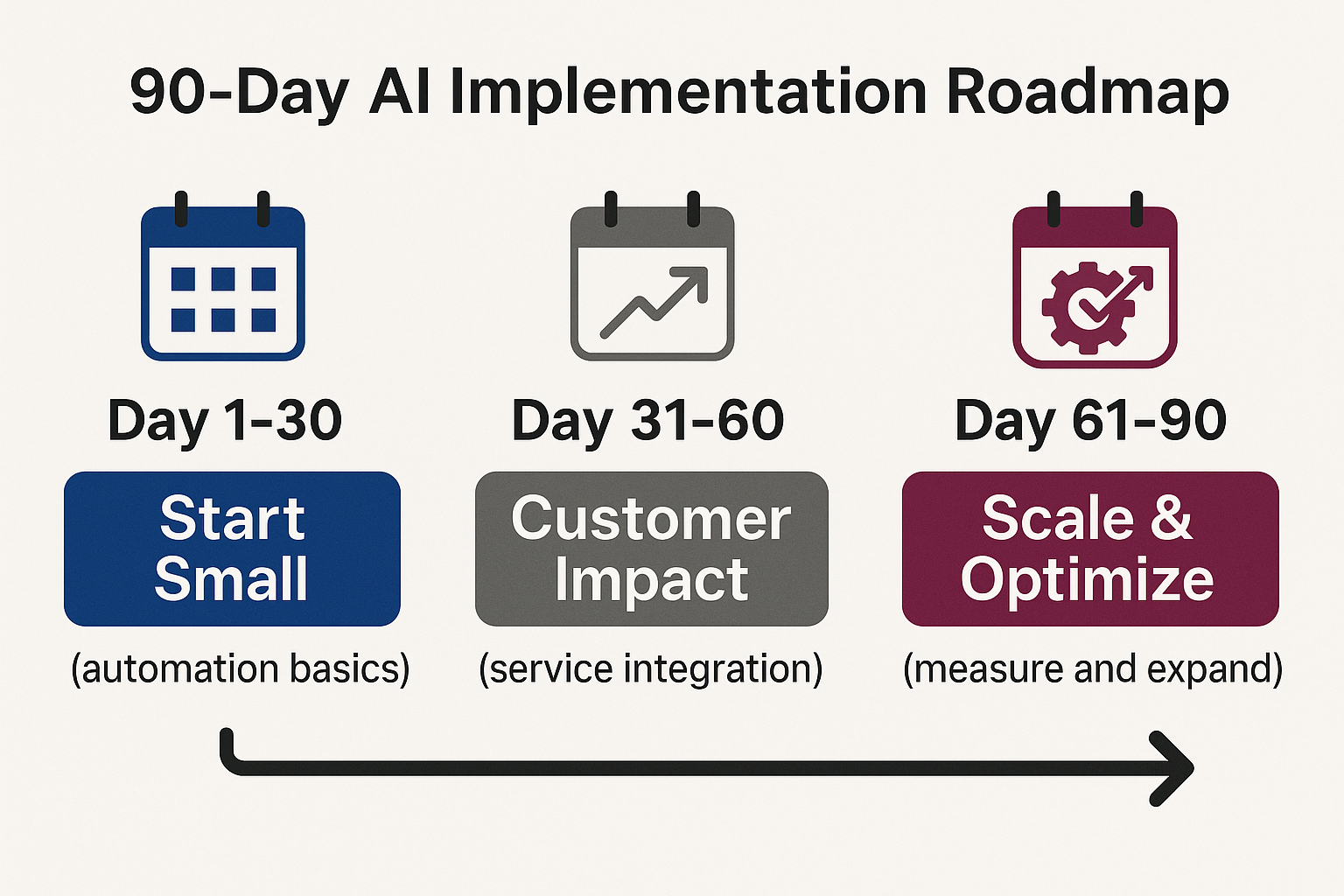
My Personal 90-Day Implementation Strategy
After nearly getting burned, I developed a much smarter approach to AI adoption:
Days 1-30: Start Small, Win Big I began with one simple automation, appointment scheduling. Nothing fancy, but it immediately freed up 5 hours per week. This built my confidence and showed my team that AI wasn’t just hype.
Days 31-60: Customer-Facing Impact Next, I implemented AI in our customer service workflow. Response times improved by 60%, and customer satisfaction scores went up. This is where I started seeing real business impact.
Days 61-90: Scale and Optimize Now I had proof of concept. I measured everything, fixed what wasn’t working, and expanded successful automations to other areas of the business.
The Metrics That Actually Matter
Through trial and error, I’ve identified the four KPIs that tell you if your AI investment is working:
- Time Recovery: I track hours saved per week religiously. Our current automation saves us 23 hours weekly.
- Cost Impact: What’s the real ROI after implementation costs? We’re seeing 340% ROI after six months.
- Revenue Growth: Are we converting more leads or serving customers better? Our conversion rate increased by 28%.
- Operational Excellence: Fewer errors, faster processes. Our error rate dropped by 45%.
What I Wish Someone Had Told Me
Here’s the truth nobody talks about: genuine AI automation can be transformative for small businesses. I’ve seen it work miracles, saving dozens of hours weekly, cutting operational costs by 30%, and dramatically improving customer experience.
But most solutions being sold right now are just expensive wrappers around tools you already have access to.
My Challenge to Every Small Business Owner
Before you sign any AI contract, use my 5-question test. I guarantee it will either save you thousands or give you confidence that you’re making a smart investment.
And if a vendor gets defensive about these questions? Run. That tells you everything you need to know.
The AI revolution is real, but so are the charlatans trying to profit from your excitement. Don’t let them.
- Your Next Step
Let's Build Your Advantage
If you are ready to move beyond discussion and start implementing intelligent solutions that deliver a measurable impact, let's talk. I am selective about the projects I take on, focusing on partnerships where I can create significant, lasting value.
FAQs
That’s actually your biggest red flag. Legitimate AI companies are proud of their technology and happy to discuss it transparently. If a vendor deflects, changes the subject, or claims “proprietary secrets,” they’re likely selling you an overpriced wrapper. I’ve learned to walk away immediately when this happens, it’s saved me from multiple bad investments.
Based on my experience, genuine AI solutions for small businesses typically range from $200-2,000 per month, depending on complexity and scale. If someone is quoting you $20,000+ upfront for basic automation, that’s a major warning sign. Start small, even a $500/month solution that saves you 10 hours weekly delivers incredible ROI.
Absolutely, and I encourage you to try! Many basic business automations can be built using Zapier ($20-100/month) plus ChatGPT API access (usually under $50/month). If you can replicate 80% of a vendor’s functionality this way, don’t pay enterprise prices. I built our first customer service automation myself in about 6 hours.
In my experience, you should see measurable results within 30-45 days if the solution is genuine. Time savings are usually immediate, cost reductions become clear within 60 days, and revenue impact typically shows up in 90 days. If a vendor can’t give you a clear timeline or promises “it takes 6 months to see benefits,” be skeptical.
Trying to automate everything at once. I made this mistake early on and it was a disaster. Start with one simple, repetitive task that already works well manually. Perfect that automation, measure the results, then expand. Also, never implement AI without having a human backup plan, technology fails, and you need to keep serving your customers when it does.