How AI Automation Helps Me Save Time, Cut Costs, and Win More Clients
Learn how to spot fake AI solutions vs. real automation. Use our 5-question test to save costs, boost revenue, and scale your SMB with AI.
Executive Summary
In today’s competitive legal landscape, first impressions define client trust. I find my law firm is not only judged on courtroom expertise but also on how quickly and smoothly I handle client communication.
An AI-powered chatbot can transform the way I operate my solo or small practice, managing intake forms, timelines, payment policies, and logistical questions in real time.
The result: lower administrative workload, faster responses, happier clients, and a measurable boost in my revenue.
This guide explains the challenges I face as a law firm, the data behind them, and a practical framework for adopting AI automation for my small business safely and effectively.
Problem Definition: The Client Service Challenge
For my solo or small law firm, the balance between legal work and administrative duties is increasingly difficult. t My clients expect speed, clarity, and consistency, and they judge my firm not just on results, but on how responsive I am to basic queries.
Tasks like scheduling, document collection, or answering repetitive questions are critical but time-consuming. When they’re delayed or handled manually, my productivity drops, costs rise, and clients may walk away before engagement even begins.
In short: administrative inefficiency quietly costs me both time and clients.
Evidence and Market Analysis: The Cost of Inefficiency
- The Wall Street Journal reports that small businesses, including law firms, spend over 20% of their time on non-core tasks.
- NFX data shows that slow or inconsistent first responses are among the top reasons clients choose competitors.
- On forums like Reddit’s LegalPractice community, attorneys frequently cite admin overload and follow-up delays as major causes of lost business and burnout.
The takeaway: inefficiency isn’t just a workflow issue for me, it’s a profitability problem.
Solution Framework: AI Automation for My Small Business
This is where AI automation makes an immediate impact for me. With the right setup, I can deploy AI-powered chatbots that operate across my website, WhatsApp line, or even directly through email.
These chatbots don’t offer legal advice; they handle logistics: directions, FAQs, intake forms, timelines, and payment details. Each client interaction strengthens the system’s intelligence, building a growing knowledge base for me over time.
It’s like training a 24/7 digital receptionist, one that never misses a question and keeps improving.
Key benefits for me:
- Reduced administrative time
- Faster, more consistent responses
- Lower operational costs
- Higher client satisfaction and retention
Ultimately, by automating what doesn’t require my legal judgment, my team and I can spend more time practicing law, not managing logistics.
Implementation Roadmap: How I Can Adopt AI Automation
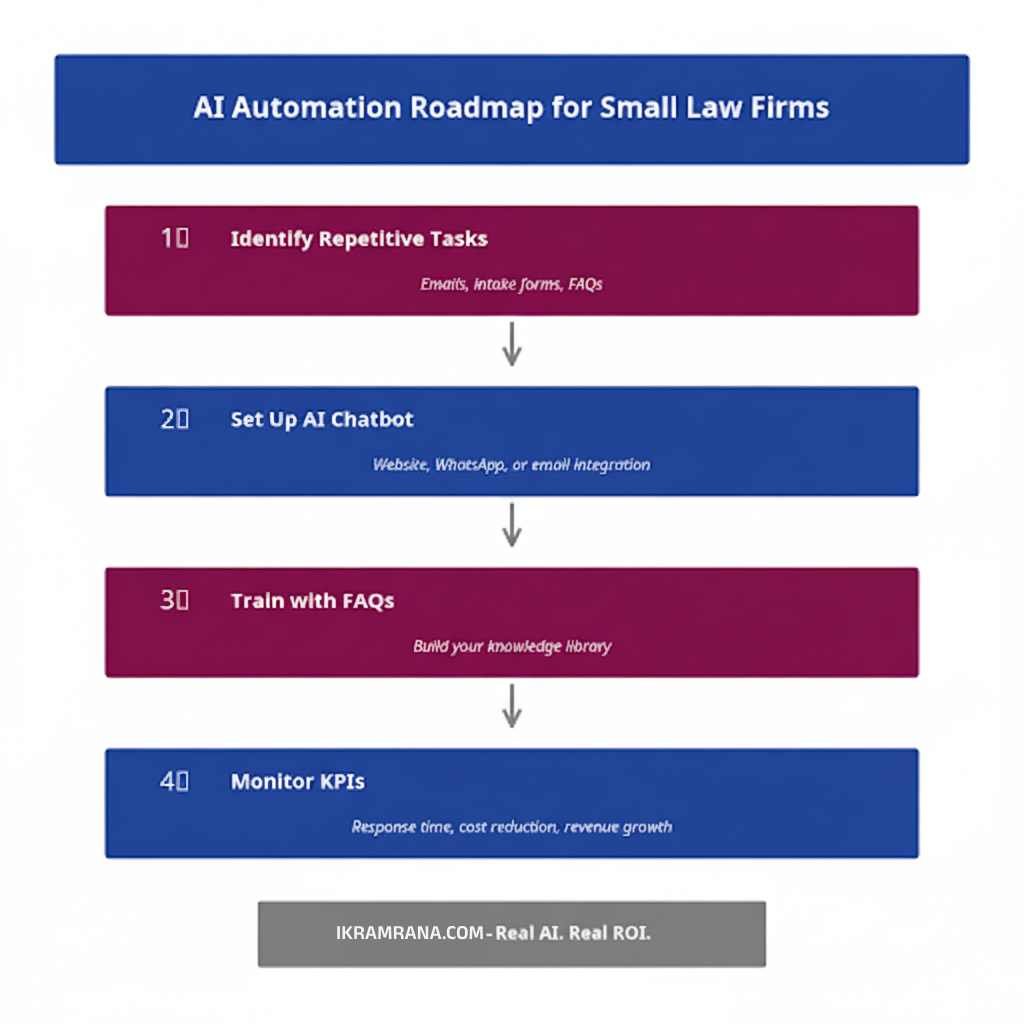
Identify repetitive tasks
I start with high-volume, low-risk activities: intake questions, payment policies, directions, scheduling.
Choose secure AI tools
I partner with automation experts (like Ikramrana) who ensure data privacy, encryption, and compliance with Canadian storage standards.
Train the system
I feed my existing FAQs and responses into the chatbot. It will use these as training data for future inquiries.
Integrate and monitor
I connect my AI assistant to my website, WhatsApp line, or email inbox. I track its performance and update responses as my library grows
At Ikramrana.com, they’ve helped Ontario-based law firms like mine set up secure, compliant workflows that automate the busywork while maintaining the personal client experience that builds trust.
KPI Tracking Checklist: Measuring My Success
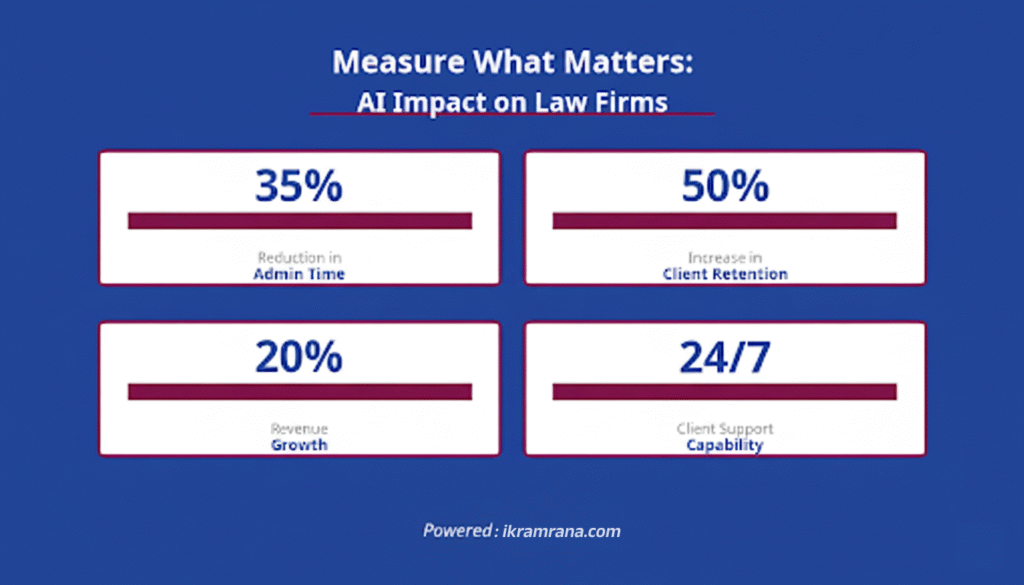
Measuring outcomes is essential for me to understand ROI. I track the following key metrics:
- Cost Reduction: Drop in my administrative labor and communication overhead.
- Time Savings: Hours I save per week on repetitive tasks.
- Revenue Growth: Increase in my billable hours or new client conversions.
- Process Efficiency: Faster turnaround and improved client feedback for my firm.
These metrics provide tangible proof of how AI automation for my small business impacts both my workflow and revenue.
- Your Next Step
Let's Build Your Advantage
If you are ready to move beyond discussion and start implementing intelligent solutions that deliver a measurable impact, let's talk. I am selective about the projects I take on, focusing on partnerships where I can create significant, lasting value.
FAQs
ROI varies by scale, but firms like mine typically report 25–40% reductions in admin costs and a clear boost in client engagement after implementation.
Setup can often be completed in 2–4 weeks, depending on the number of workflows I need automated and the integrations required.
Common issues include resistance to new tools and a lack of internal training. With structured onboarding, my team and I can adapt quickly, often within days.
I begin with administrative questions and intake areas where consistency and quick responses make the biggest client-experience impact.
Conclusion
AI isn’t here to replace my expertise; it’s here to amplify it. By automating repetitive, non-billable work, I can deliver faster service, reduce my costs, and strengthen client confidence from the very first interaction.
(Adapted section): At Ikramrana.com, they specialize in building AI-native workflows that turn small business operations, like mine, into scalable, efficient systems—securely and affordably.